Fleet Tracking Software: The Complete Buyer’s Guide for 2026
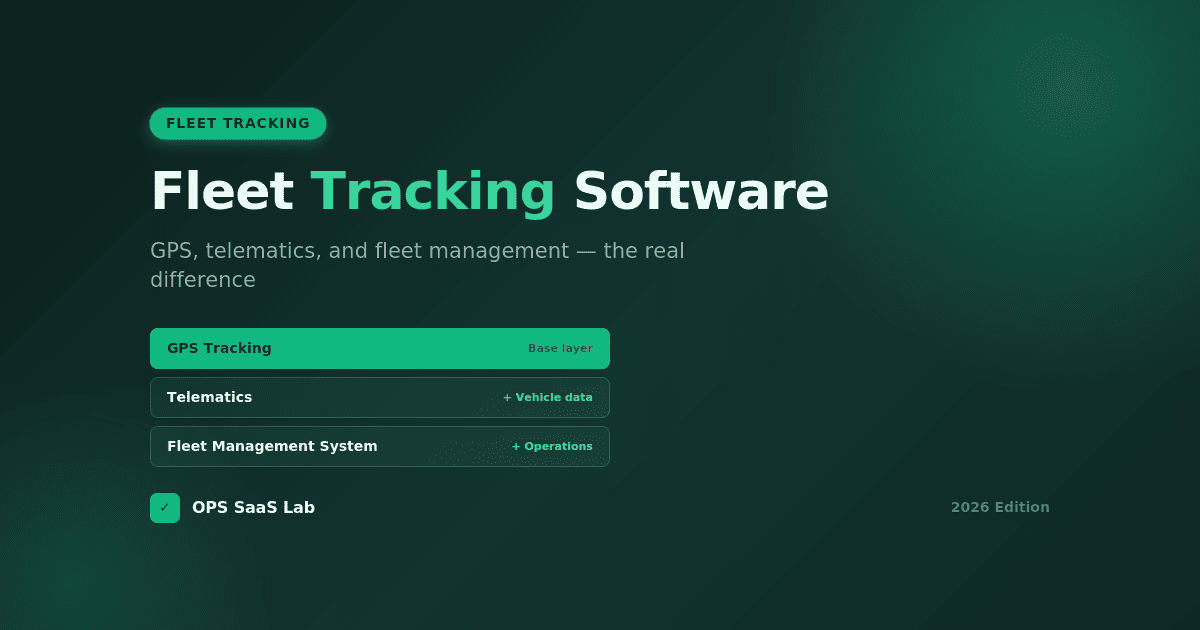
“GPS tracking,” “telematics,” and “fleet management system” get used interchangeably in almost every article on this topic — including plenty written by the vendors selling these systems. That’s not a small confusion. Each term describes something genuinely different in scope, and buying based on the wrong one means either overpaying for capability you won’t use, or under-buying and hitting a wall in six months.
This guide sorts that out first, then covers what these systems actually cost — with real contract terms most comparison articles leave out — and how to choose based on your fleet size, not a vendor’s default recommendation.
Quick answer: Fleet tracking uses GPS to monitor vehicle location. Telematics adds engine diagnostics, fuel data, and driver behavior on top of that location data. A fleet management system uses telematics data to run day-to-day operations — dispatch, maintenance, compliance. Pricing runs roughly $10-60 per vehicle monthly depending on tier, plus hardware and contract terms that vary significantly by vendor.
What Is Fleet Tracking?
Fleet tracking is the use of GPS-connected devices to monitor the real-time location, route history, and movement of vehicles in a business fleet. At its simplest, it answers one question: where is this vehicle right now?
That simplicity is also its limit. Basic fleet tracking tells you location — nothing about how the vehicle is being driven, whether it needs maintenance, or how efficiently it’s being used. For that, you need the broader systems covered below.
GPS Tracking vs. Telematics vs. Fleet Management System: The Real Hierarchy
Most articles on this topic explain a two-way comparison — GPS versus telematics — and stop there. That misses a third layer that actually matters more for a buying decision: these three terms aren’t three alternatives to choose between. They’re three nested layers, each built on the one below it.
| GPS Tracking | Telematics | Fleet Management System | |
|---|---|---|---|
| Answers | Where is the vehicle? | How is it running and being driven? | How do I manage the whole operation? |
| Core data | Location, route, speed | + Engine diagnostics, fuel use, harsh braking, idling | Telematics data + maintenance schedules, compliance, dispatch |
| Data source | Satellite positioning | GPS + a physical connection to the vehicle (commonly the OBD-II port) | A software platform built on top of telematics data |
| Best fit | Simple location or mileage tracking | Company-owned fleets needing operational insight | Fleets needing full day-to-day operational control |
GPS tracking is the base layer: a device using satellite positioning to report where a vehicle is and where it’s been.
Three Nested Layers, Not Three Alternatives
Tap each layer to see exactly what it adds on top of the one below it.
Telematics sits on top of GPS. A telematics device connects directly to the vehicle — typically through the OBD-II diagnostic port — and reads far more than location: engine health, fuel consumption, speed, harsh braking, idling time, and dozens of other data points reported directly from the vehicle's own systems.
A fleet management system is the platform that takes all that telematics data and turns it into operational decisions: scheduling preventive maintenance, tracking regulatory compliance, managing dispatch, and reporting on cost per mile across the whole fleet. It's not a fourth type of hardware — it's software built to act on the data telematics already collects.
The practical distinction worth remembering: if you only need to know where vehicles are, GPS tracking alone is enough. If you need to know how they're performing and being driven, you need telematics. If you need to run fleet operations day to day — maintenance, compliance, dispatch — you need a full fleet management system, which is almost always sold as a complete platform rather than assembled from separate pieces.
How Fleet Tracking Devices Actually Work
Fleet tracking hardware comes in a few genuinely different forms, and the type you need depends on what you're tracking and why.
- OBD-II plug-in devices — the most common type for company vehicles. They plug directly into the vehicle's onboard diagnostics port, requiring no wiring or professional installation, and immediately begin pulling both location and engine data.
- Hardwired devices — installed directly into a vehicle's electrical system, typically by a professional installer. These are harder to remove (a deliberate anti-tamper feature) and are common in vehicles without an accessible OBD-II port, such as older trucks or heavy equipment.
- Battery-powered asset trackers — used for equipment that has no engine to plug into: trailers, generators, shipping containers, construction equipment. These run on internal batteries, often lasting months between charges, and report location on a set interval rather than continuously.
- AI dashcams — increasingly bundled with telematics hardware, these add video evidence alongside data: recording driving footage, detecting collisions, and in more advanced systems, flagging distracted or risky driving behavior in real time.
Most fleets end up using more than one type — OBD-II devices on the powered fleet, asset trackers on trailers and equipment that travel separately.
Core Features of Fleet Tracking Software
Beyond raw location data, most fleet tracking platforms are built around the same core capabilities:
- Real-time GPS location and route history — the baseline every platform offers.
- Geofencing — automatic alerts when a vehicle enters or leaves a defined area, used for everything from job-site verification to after-hours misuse alerts.
- Driver behavior scoring — tracking harsh braking, rapid acceleration, and speeding to flag risky driving before it causes an incident.
- Fuel and idle monitoring — identifying excessive idling and fuel waste, which is often the fastest-payback feature in the entire platform.
- Maintenance alerts — mileage- or engine-hour-based reminders for service, reducing breakdowns caused by missed maintenance windows.
- ELD compliance — for commercial trucking specifically, Hours of Service logging required under the FMCSA's Electronic Logging Device rule, a federal mandate that has driven a large share of telematics adoption in trucking specifically.
Not every platform includes every feature at every tier — ELD compliance and driver-facing AI dashcams in particular are commonly gated to higher-priced plans.
Fleet Fuel Management: Why It's Often Bundled In
Fuel is frequently the single largest controllable operating cost for a vehicle fleet, which is why fuel management shows up as a core module in most fleet tracking platforms rather than a separate add-on.
Fleet fuel management typically covers three things: fuel card integration (matching card transactions to actual vehicle location to catch fraud or unauthorized purchases), idle-time tracking (since excessive idling burns fuel without producing any mileage), and route optimization (reducing total miles driven, which reduces fuel spend directly). Some platforms also flag driving behaviors — hard acceleration, speeding — that measurably increase fuel consumption independent of route efficiency.
For fleets running any meaningful number of vehicles, fuel data is usually where the fastest, most easily-measured return on a tracking investment shows up, well before harder-to-quantify benefits like safety improvements or maintenance savings.
Who Needs Fleet Tracking Software?
Fleet tracking fits any business where vehicles are a meaningful operating cost or safety risk:
- Trucking and long-haul logistics — where ELD compliance is often legally required, not optional.
- Local delivery and last-mile fleets — where route efficiency and delivery-window accuracy directly affect customer experience and cost.
- Construction and heavy equipment — where asset trackers on non-powered equipment matter as much as vehicle GPS.
- Field service businesses — HVAC, plumbing, electrical, and similar trades tracking technician vehicles; this overlaps meaningfully with field service management software, covered in our Field Service Management Software guide.
- Government and municipal fleets — where public accountability and fuel cost control both create pressure to track usage.
How Much Does Fleet Tracking Software Cost?
Published pricing in this category varies substantially by vendor, tier, and — critically — by contract terms that most comparison pages don't emphasize enough.
| Platform | Price Range (per vehicle/mo) | Typical Contract | Notable |
|---|---|---|---|
| Geotab | ~$10-18 base (up to ~$30 via some resellers) | Flexible, sold through 2,000+ resellers | Lowest typical entry price; terms vary by reseller |
| Motive | ~$20-35 (some sources report up to $50 with add-ons) | Month-to-month available, or 12-month | Strong ELD/compliance focus |
| Azuga | ~$25-35 across three published tiers | Often 36-month | Rare among major players for publishing clear tiered pricing |
| Verizon Connect | ~$20-45 | 3-year typical | Reported pricing varies significantly by region |
| Samsara | ~$27-33 base, $40-60+ with AI cameras/full suite | 3-year typical | Hardware $99-148/vehicle self-install |
| Fleetio | ~$4-10 + hardware | Flexible | Maintenance-first rather than telematics-first |
Figures reflect the most commonly cited ranges across multiple independent comparison sources, checked 2026. Samsara, Verizon Connect, Motive, and Geotab do not publish fixed pricing — every number above is a reported range, not a quote. Confirm current pricing directly before deciding.
The detail most listicles skip: contract length is often the bigger cost decision than the monthly rate. Several major providers require 36-month contracts with early-termination penalties tied to the remaining contract value — one detailed comparison found a 25-vehicle fleet exiting a Samsara contract in month 14 could owe more than $18,000 in remaining-balance fees. Before comparing monthly per-vehicle pricing, confirm the contract length and what happens if you need to exit early.
Hardware is typically a separate cost on top of the subscription — commonly $99-250 per vehicle depending on device type and whether professional installation is required.
What's Your Early-Exit Exposure?
Multi-year fleet tracking contracts charge the remaining balance if you exit early. See roughly what that adds up to.
$750
total monthly cost
$16,500
estimated early-exit exposure
Illustrative estimate based on remaining months × monthly cost — the same math behind the widely-cited case of a 25-vehicle fleet owing over $18,000 exiting a 36-month contract at month 14. Actual early-termination terms vary by vendor and contract — confirm the exact clause before signing, not after.
Choosing the Right Tracker for Your Fleet Size
The right platform changes meaningfully with fleet size, not just budget:
Which Tracker Fits Your Fleet?
Drag to your vehicle count for a straight recommendation.
Under 10 Vehicles
Simple GPS tracking
No-contract, lower-cost options are usually enough. Full telematics is often more than you need at this size.
10-50 Vehicles
Full telematics platform
This is where fuel and maintenance data typically start paying for themselves. Compare contract flexibility as closely as price.
50+ Vehicles, or Regulated Trucking
Full fleet management system
ELD compliance usually becomes non-negotiable, and fleet-wide reporting depth starts to matter more than per-vehicle cost.
- Under 10 vehicles: Simpler, no-contract options (lower-cost GPS-only trackers) are often enough. Full telematics platforms may be more capability than a small fleet needs, and the contract terms of major providers can be disproportionately restrictive at this scale.
- 10-50 vehicles: This is where full telematics — not just GPS — typically starts paying for itself, through fuel savings and maintenance scheduling alone. Compare providers on contract flexibility as closely as on price.
- 50+ vehicles, or regulated trucking: ELD compliance usually becomes non-negotiable, and the reporting depth of platforms like Samsara or Verizon Connect starts to matter for fleet-wide cost management, not just individual vehicle tracking.
Real-World Examples: Popular Fleet Tracking Platforms
A handful of platforms dominate this category, each with a different core strength:
- Samsara — broad, modern platform known for AI dashcam integration and safety coaching, at a premium price point.
- Geotab — an open-data platform sold through a large reseller network, typically the lowest-cost entry among major providers.
- Motive (formerly KeepTruckin) — strong compliance and ELD focus, popular specifically in trucking.
- Verizon Connect — enterprise-oriented, commonly chosen by larger fleets needing deep integrations.
- Azuga — owned by Bridgestone, known for straightforward, clearly published tiered pricing — uncommon in this category.
- Fleetio — positioned around maintenance tracking first, telematics second, making it a natural crossover point with CMMS — covered in full in What Is CMMS? The Complete Guide.
This isn't a ranked list — the right fit depends heavily on fleet size, industry, and whether compliance is a legal requirement or a nice-to-have.
FAQs
What is fleet tracking?
Fleet tracking is the use of GPS-connected devices to monitor the real-time location, route, and movement of vehicles in a fleet. It's the foundational layer that telematics and fleet management systems build on.
What is a telematics device?
A telematics device connects to a vehicle — typically through the OBD-II port — to collect data beyond location, including engine diagnostics, fuel consumption, speed, and driving behavior like harsh braking or idling.
What is the difference between GPS tracking and telematics?
GPS tracking tells you where a vehicle is. Telematics tells you how it's running and being driven, using data pulled directly from the vehicle's systems. Telematics includes GPS, but adds engine and behavior data on top.
What is a fleet management system?
A fleet management system is software that uses telematics data to run day-to-day fleet operations — scheduling maintenance, tracking compliance, managing dispatch, and reporting on cost across the entire fleet.
How does a fleet management system work?
It collects data from GPS and telematics devices installed across the fleet, then organizes that data into dashboards and workflows for maintenance scheduling, compliance tracking, driver safety scoring, and dispatch decisions.
What are the benefits of a fleet management system?
Common benefits include reduced fuel costs through idle and route monitoring, fewer breakdowns through maintenance alerts, improved driver safety through behavior scoring, and simplified regulatory compliance through automated logging.
How much does fleet tracking software cost?
Most platforms run $10-60 per vehicle monthly depending on features, with hardware typically $99-250 per vehicle extra. Contract length varies significantly — some providers require 36-month commitments with steep early-termination costs.
What is fleet fuel management?
Fleet fuel management tracks and controls fuel spend through fuel card integration, idle-time monitoring, and route optimization. It's commonly the fastest-payback feature in a fleet tracking platform, since fuel is often the largest controllable cost per vehicle.
Is cloud-based fleet management better than on-premise?
Nearly all modern fleet tracking platforms are cloud-based, since real-time GPS and telematics data depend on continuous connectivity regardless of where it's processed. On-premise fleet management is now uncommon outside legacy enterprise systems.
What types of GPS tracking devices are there?
The main types are OBD-II plug-in devices (fastest to install, most common for company vehicles), hardwired devices (for vehicles without accessible OBD-II ports), and battery-powered asset trackers (for trailers and equipment with no engine).
