GPS Fleet Tracking Reviews: What Users Say About Accuracy and Real-Time Data
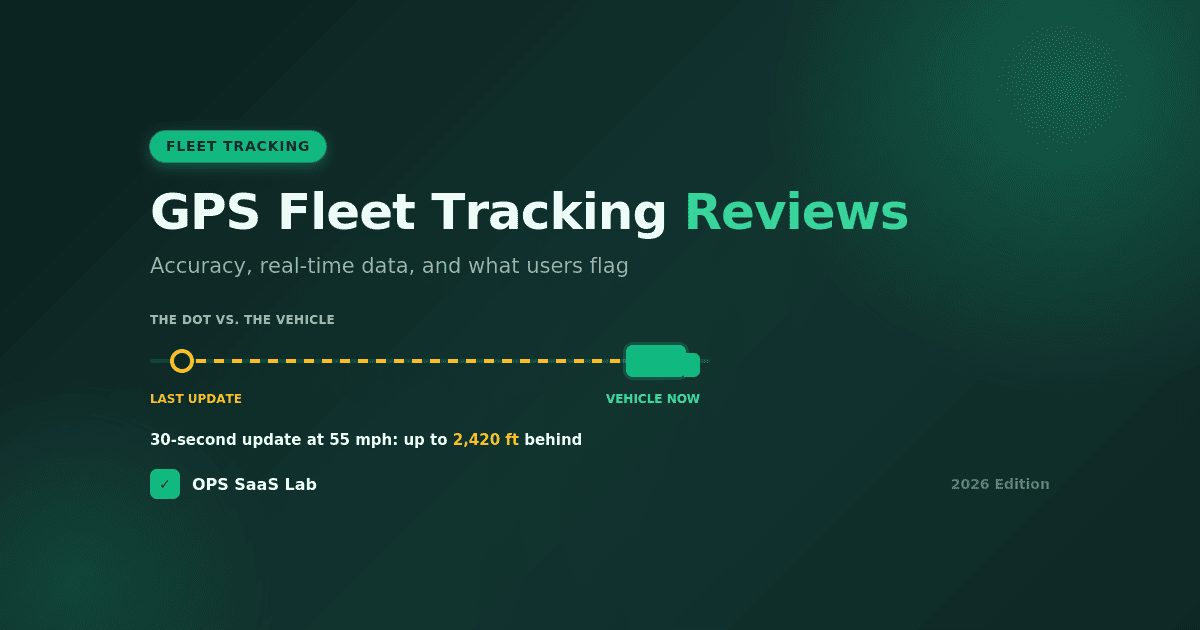
Most GPS fleet tracking reviews end up praising the same thing: the dot on the map. Reviewers love seeing their trucks move in real time. What gets less attention is how often that dot is late, off by a block, or missing entirely while the truck sits in a dead zone, and how many one-star reviews have nothing to do with GPS at all.
This guide reads the reviews with that in mind. It covers providers that our companion review of the big platforms left out, checks what the US government says about GPS accuracy, and explains what “real-time” actually means when a vendor uses the word.
Quick answer: GPS fleet tracking reviews praise live visibility and criticize the business around it: cancellation, support, device failures, and software glitches. Accuracy complaints exist but are rarer. Real-time rarely means instant: updates range from seconds to minutes, and a tracker out of cellular range stores positions and uploads them later.
Table of Contents
How We Read These Reviews
Every rating here comes from G2, Capterra, Trustpilot, or the provider’s own listing on those sites, cross-checked across at least two where possible. Complaints and praise are paraphrased from patterns, not copied.
One filter matters more than any rating. G2 and Capterra label reviews that the vendor invited or incentivized, using tags like “Vendor Referred – Incentive Offered.” That doesn’t make those reviews false, but it explains why vendor-solicited platforms often score higher than Trustpilot, where reviews arrive unprompted. We note below where that shows up.
How Much Should You Trust That Rating?
Enter what a review site shows for a provider. Tap an example to see how it works.
How many reviews?
Are reviews labeled vendor-invited or incentivized?
This reflects how this guide weighs reviews: larger samples count more, vendor-invited or incentivized labels count against, and unprompted sources count most. It rates how much weight a score deserves, not whether the product is good.
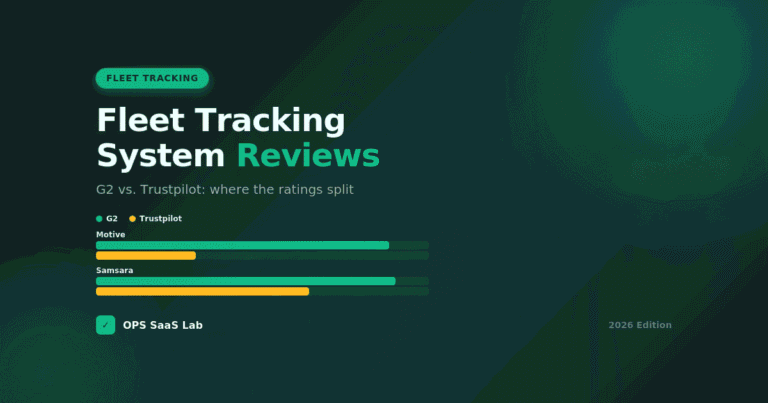
This post deliberately skips Samsara, Geotab, Motive, Verizon Connect, and Azuga, which we cover in Fleet Tracking System Reviews: What Real Users Actually Say. Here we look at providers outside that group.
GPS Fleet Tracking Provider Ratings at a Glance
| Provider | Capterra | G2 | Trustpilot |
|---|---|---|---|
| Teletrac Navman | Not verified | ~3.5-4.0 (about 24 reviews, reported inconsistently) | 4.4 (about 2,950 reviews) |
| Linxup | 3.9 (88 reviews) | 4.6 (12 reviews, vendor-invited) | 2.3 (13 reviews) |
| ClearPathGPS | 4.9 (214 reviews) | Not verified | Not verified |
| One Step GPS | 4.8 (265 reviews) | Not verified | Not verified |
| GPS Insight | 4.5 (242 reviews) | Not verified | Not verified |
Review counts and scores change continuously and are reported inconsistently by secondary sources. Treat this as a snapshot checked in 2026, and confirm current numbers on each site. Where a cell says "Not verified," we could not confirm a figure from the review site itself.
Two Providers Worth Reading Closely
Teletrac Navman
Teletrac Navman shows the opposite of the pattern we saw with Motive in our companion post. Its Trustpilot score is high (4.4 across nearly 3,000 reviews), while its G2 score sits lower on a very small base of about two dozen reviews, reported anywhere from 3.5 to 4.0 depending on the source.
What reviewers praise: Live visibility and practical day-to-day tracking, plus idle-time reports, geofence alerts, and maintenance reminders. Many Trustpilot reviewers describe good experiences with individual support agents.
What reviewers flag: The interface is often called dated next to newer platforms, and reporting is described as complex with a steep learning curve. Review-site summaries also list software glitches, including lost GPS connections and inconsistent data reporting, plus complaints about device faults, mileage tracking, and support response times. Individual Trustpilot reviewers describe devices that did not report accurately or cameras that lacked a promised live view. Those are single accounts rather than a measured failure rate, but they are the closest thing to accuracy complaints in this set.
How to read the gap: A Trustpilot score this much higher than G2, on a G2 sample this small, isn't a verdict either way. We can't see from outside how each site gathered its reviews.
Linxup
Linxup is aimed at small and mid-size fleets, and its reviews split sharply by site.
What reviewers praise: Ease of use is the consistent strength. Capterra reviewers rate it 4.1 out of 5 for ease of use, call the interface intuitive, and note that it scales from a handful of vehicles to hundreds. One reviewer specifically liked that the tracker reports more often in turns, which gives a more accurate path.
What reviewers flag: Mobile app lag and outdated screens, devices that break or prove unreliable, inconsistent customer service (3.7 out of 5 for support), and one reviewer who found the data storage too limited for their industry's compliance needs. On Trustpilot, 11 of 13 reviews are one-star, with a recurring theme of an easy signup and a hard cancellation.
How to read the gap: Linxup's G2 score is 4.6 and its Trustpilot score is 2.3, but both rest on a dozen or so reviews, and the G2 reviews carry the "invite on behalf of seller" and "incentivized" labels. That is a wide gap on small samples, which is exactly the situation where you should ask questions rather than draw a conclusion. Capterra, the largest base here at 88 reviews, lands in the middle at 3.9, with 17% of reviewers giving one star.
Providers With High Ratings and Thin Review Trails
Several providers post very high Capterra scores: ClearPathGPS at 4.9 across 214 reviews, One Step GPS at 4.8 across 265, and GPS Insight at 4.5 across 242. Those are strong, sizeable review bases.
What we could not verify is how they fare on G2 and Trustpilot, so we can't describe their complaint patterns. In this category a high score on one site is where the gap check starts, not where it ends. Before shortlisting any of them, read the lowest-rated recent reviews and look for cancellation, billing, and device-reliability themes.
What "Real-Time" Actually Means
Vendors use "real-time" for very different things. A fleet GPS tracking app showing a moving dot doesn't tell you how old that position is.
GPS itself needs no internet. A tracker calculates its position from satellite signals on its own. The cellular connection is what delivers that position to your dashboard. GPS finds the location; cellular carries it.
That is why published update rates vary so much:
| Approach | Published refresh rate | Source type |
|---|---|---|
| Typical cellular fleet systems | Every 10-30 seconds | One fleet-technology guide |
| One major platform's hardware | Location collected every second, sent over LTE | A connectivity provider's description |
| OBD plug-in trackers | Every 3 seconds, every 5 seconds while moving, and every 15 seconds while driving, depending on the product | Seller specifications |
| Bluetooth tags relayed by nearby phones | Only when a nearby phone passes, or minutes at best through business services | Vendor and comparison pages |
Nearly all of these figures are published by the companies selling the product. Treat them as claims to confirm, not measurements.
Two practical points follow. First, a shorter interval is not automatically better, because on battery-powered units it drains the battery faster. Second, ask for the interval at the plan tier you're actually buying, not the best case on the product page. Our guide to Best Fleet Tracking Devices covers which hardware type reports how often.
GPS Accuracy: What the Government Says
How accurate is GPS? The US government's GPS.gov reports that GPS-enabled smartphones are typically accurate to within about 4.9 meters (16 feet) under open sky, and that accuracy worsens near buildings, bridges, and trees. It also notes that the government's accuracy commitments apply to the signals broadcast from space, not to any particular device.
That last point matters for reading reviews. A tracker's real accuracy depends on its receiver, antenna placement, and where the vehicle is. Some sellers advertise 1.5 to 3 meters for fleet trackers in open sky. Treat that as a best case. In a city with tall buildings, a position can be noticeably off, which is worth knowing before a reviewer's "inaccurate GPS" complaint makes you assume the product is broken.
Accuracy and freshness are also different problems. A dot can be in exactly the right place and still be a minute old. When a review says "the GPS is off," it helps to ask whether the complaint is about position or about delay. See GPS.gov's accuracy page for the official explanation.
How Far Behind Can the Dot Be?
Pick an update interval and a driving speed. See how far the vehicle can travel between updates, compared with GPS's own error.
Update interval
30 sec
worst-case age of the dot
2,420 ft
distance covered in that time
151x
the 16 ft open-sky GPS error
Worst case is the moment just before the next update, assuming straight-line driving at constant speed. GPS error figure: GPS.gov reports smartphones are typically accurate to within about 4.9 m (16 ft) under open sky. Bars use a compressed scale so small values stay visible. Intervals shown are examples drawn from published seller claims; confirm yours with the provider.
Can GPS Trackers Work Without Internet?
Yes, in part. A tracker without cellular signal still calculates its position from satellites, but it cannot send that position to your dashboard until it reconnects.
Most modern fleet trackers use what's called store-and-forward. They keep recording positions in onboard memory while out of coverage, then upload the backlog once signal returns, so the route history stays complete even though the live view had a gap. Some units only log for later download, and satellite-connected versions exist for areas with no cellular coverage.
How far can a tracker track a car? A cellular GPS tracker has no distance limit as long as it has coverage. Without coverage it logs and uploads later. Bluetooth tags only report when they're within short range of a nearby phone, which makes them unsuitable for tracking a moving vehicle.
How to Test a Provider Before You Sign
Reviews tell you what others experienced. A short trial tells you what you will. If a provider offers a demo or trial period, test these:
- Drive a loop that includes a dead zone. A tunnel, a rural stretch, or a basement garage works. Check that the route fills in after the vehicle reconnects.
- Compare the dashboard with a phone map. Note any delay and any position that's visibly off.
- Check the update interval at your plan tier, and see how it behaves when the vehicle is stopped.
- Open a support ticket on purpose. Time the response. Support is the most common complaint across providers.
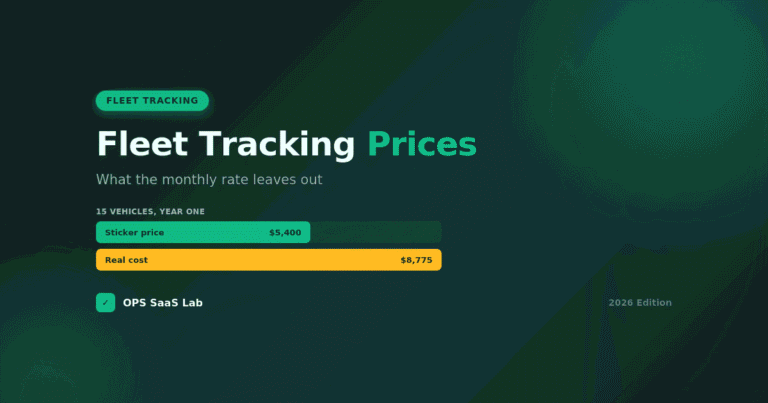
- Read the cancellation terms before signing. Pull the early-termination clause and the renewal notice period. Our guide to Fleet Tracking Prices has a checklist of eight questions to put in writing.
For the basics of GPS versus telematics versus a full fleet management system, start with What Is Fleet Tracking?.
FAQs
What is the best GPS tracker for fleet tracking?
It depends on fleet size and support needs. Among providers reviewed here, Teletrac Navman and Linxup both earn praise for live tracking, but both draw complaints about devices or cancellation. Check G2, Capterra, and Trustpilot before choosing.
How accurate is GPS fleet tracking?
GPS.gov reports smartphones are typically accurate to within about 4.9 meters (16 feet) under open sky, worse near buildings, bridges, and trees. Some sellers claim 1.5 to 3 meters for fleet trackers, which should be treated as a best case.
How often does a GPS fleet tracker update?
Published rates range from every few seconds to about 30 seconds for cellular fleet systems, with Bluetooth-based options far slower. Most of these figures come from sellers, so confirm the interval for the plan you're buying.
Can GPS trackers work without internet?
Partly. A tracker calculates its position from satellites without internet, but needs cellular data to send it to your dashboard. Most store positions while out of coverage and upload them when signal returns.
How far can a tracker track a car?
A cellular GPS tracker has no distance limit while it has coverage. Out of coverage, it records positions and uploads them later. Bluetooth tags only report near a phone, so they don't suit moving vehicles.
Is there a monthly fee for a GPS tracker?
For real-time tracking, yes. The fee covers the cellular connection and the software. Devices sold with no monthly fee usually log data locally or offer limited reporting. See our fleet tracking prices guide for the full breakdown.
Why do GPS fleet tracking reviews disagree between sites?
Sites collect reviews differently. G2 and Capterra label vendor-invited and incentivized reviews, which tend to skew positive, while Trustpilot reviews arrive unprompted. Small samples also swing scores sharply, so check review counts alongside ratings.
What are the most common GPS fleet tracking complaints?
The most common are cancellation and billing difficulty, device failures, software glitches such as lost GPS connections, slow or inconsistent support, and dated mobile apps. Pure accuracy complaints are less frequent than business and support complaints.
Are G2 and Capterra reviews reliable?
They're useful but not neutral. Both sites mark reviews the vendor invited or incentivized. Read those labels, weigh larger samples more heavily, and compare against unprompted sources like Trustpilot before trusting a single score.
What should I test during a GPS fleet tracking trial?
Drive a route through a dead zone and confirm the route fills in afterward, compare the dashboard with a phone map for delay and accuracy, check the update interval, and time a support response.