Fleet Tracking Prices: What Should You Really Be Paying?
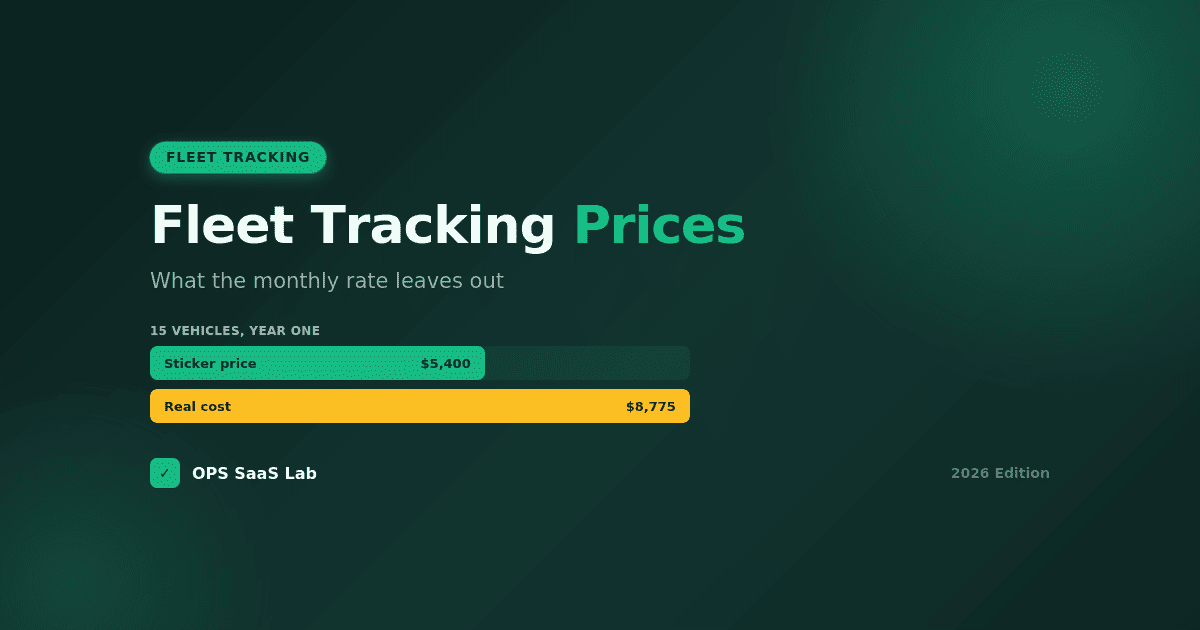
Search for what fleet tracking costs and you’ll get a tidy answer: somewhere around $20 to $45 per vehicle per month. That number is real. It’s also the smallest surprise on the invoice, because it leaves out the hardware, the installation, the activation fee, and a contract that can cost more to leave than it did to sign.
There’s a second problem with most pricing guides: the majority we found were written by companies that sell GPS trackers or related software. One comparison, published by a tracker maker, concludes that its own product has the lowest total cost of ownership. That doesn’t make the figures wrong. It does explain why the “typical” range always seems to favor whoever is writing.
This guide skips the sales angle. It breaks the price into its parts, shows where published sources disagree, and works through the math for a real fleet, so you can check any quote against numbers you trust.
Quick answer: Fleet tracking typically costs $10-50 per vehicle per month, with most fleets paying $20-45. Hardware ($50-300) and installation ($50-150 if hardwired) come on top. By our math from published ranges, the real first-year cost runs roughly 40-65% above the monthly sticker price.
Table of Contents
What Does Fleet Tracking Cost?
Most published guides put fleet tracking at $20-45 per vehicle per month, plus a one-time hardware cost of $50-300 per vehicle. Basic location tracking sits at the low end; plans with video, driver coaching, and compliance tools sit at the top.
Where sources disagree is the edges. Depending on who’s writing and what’s included, published guides give the typical monthly range as $10-50, $20-45, $20-65, or even $15-85 per vehicle. The spread comes from two things:
- What’s counted. Some figures include hardware and cellular data; others quote only the software subscription.
- Who’s selling. A budget tracker brand and an enterprise platform are describing different products under the same label.
Treat any single range as a starting reference, not a quote. Several of the major platforms, including Samsara, Verizon Connect, Motive, and Geotab, quote privately, so published numbers for them are always reported ranges.
Monthly Fleet Tracking Prices by Tier
The monthly rate is mostly decided by which features you’re paying for, not by how many vehicles you have. Across published guides, plans cluster into three tiers:
| Tier | Typical monthly price per vehicle | What it usually includes |
|---|---|---|
| Basic location tracking | ~$10-25 | Live location, trip history, basic alerts |
| Professional telematics | ~$25-45 (some guides run to $55) | Driver behavior scoring, fuel and idle reports, maintenance alerts, integrations |
| Enterprise | ~$45-65+ (can exceed $80) | AI dashcams, ELD compliance, advanced safety coaching |
Ranges reflect the most commonly cited figures across multiple pricing guides, checked 2026. Most of those guides are published by sellers, so treat the tiers as directional.
Feature gating is where the quoted rate and the final rate drift apart. One published example describes a $20 plan becoming $48 once add-ons were attached. When you compare quotes, compare them tier against tier, with the same features switched on.
What Actually Changes the Price
Fleet Size
Smaller fleets generally pay more per vehicle. One pricing guide puts fleets of 1-10 vehicles at $20-50 per vehicle monthly, against $15-40 for fleets of 10-100, because larger buyers get volume discounts. That’s a single source, so read it as a pattern rather than a rule.
Contract Length
Longer terms usually lower the monthly rate and raise the cost of changing your mind. Multi-year commitments are common with larger platforms, while month-to-month providers tend to charge more per month for the flexibility.
Hardware Model
Hardware arrives in three ways: you buy it, the vendor leases it, or it’s advertised as “free.” Free hardware isn’t free. The cost shows up as a higher monthly rate, a longer contract, or both, and the devices still have to be returned or paid for if you leave early.
Feature Tier
As the table above shows, video, ELD compliance, and coaching tools are what move a plan from $25 to $50-plus. If you only need to know where vehicles are, you’re overpaying for anything past the first tier.
The Costs Outside the Monthly Rate
This is where most budgets break. Five cost categories sit outside the advertised per-vehicle price.
Hardware and Installation
Hardware is commonly $50-300 per vehicle, with some guides reporting up to $500-600 for advanced units. Plug-in OBD-II devices run toward the low end (around $40-100), while hardwired units can reach $100-300 or more. Professional installation for hardwired devices is typically $50-150 per vehicle, though some quotes run higher. A plug-in device you install yourself costs nothing in labor. Our guide to Best Fleet Tracking Devices covers which type fits which vehicle.
Activation, Data, and Overage Charges
Activation fees run from $0 to about $75 per device. Beyond that, some contracts charge for exceeding location-ping limits, storing video clips past a set period, or exporting reports. These rarely appear in the headline price.
Add-On Features
Dashcams, ELD compliance modules, driver coaching, and fuel card integrations are frequently separate line items. Each one is reasonable on its own. Stacked together, they can double the subscription.
Replacement and Training Fees
Replacing a damaged or lost device is commonly $75-200 per unit. Some vendors also charge for onboarding or training, with figures reported in the $500-2,000 range for larger rollouts.
Early Termination
This is the cost that hurts most. Published figures vary: $100-500 per vehicle in one guide, $250-500 in another, and “50-100% of the remaining contract value” in a third. For a 15-vehicle fleet, the per-vehicle figures alone work out to $1,500-7,500 to leave. We walk through a worst-case example, and a calculator, in our pillar guide, Fleet Tracking Software: The Complete Buyer’s Guide for 2026.
Is There a Monthly Fee for a GPS Tracker?
Almost always, yes, for real-time tracking. A tracker that reports live location has to send data over a cellular network, and the monthly fee mostly pays for that connection plus the software that displays it.
Devices sold with “no monthly fee” generally work differently. They may store location data on the device for later download instead of reporting it live, include a limited prepaid data period, or cover only basic reporting. If a fleet needs live visibility, a device that doesn’t report in real time is a logger, not a tracker. Read exactly what “no monthly fee” covers before relying on it.
Do GPS trackers need a SIM card? Real-time trackers do. They contain a SIM or embedded SIM that connects to a cellular network, and the provider normally supplies it as part of the plan, so you don’t buy one separately. Loggers that only store data on the device don’t need one. Versions that connect by satellite, used in areas without cellular coverage, are priced differently from standard cellular plans.
What a 15-Vehicle Fleet Really Pays
The advertised price tells you the subscription. The real number adds everything else. Here’s the math for a mid-tier plan, using midpoints of the published ranges above. These are illustrative assumptions, not a quote:
- Subscription: $30 per vehicle per month
- Hardware: $100 per vehicle
- Professional installation: $100 per vehicle
- Activation: $25 per vehicle
| Fleet size | Sticker price (monthly) | Sticker price (year one) | Real year-one cost | Real 3-year cost |
|---|---|---|---|---|
| 5 vehicles | $150 | $1,800 | $2,925 | $6,525 |
| 15 vehicles | $450 | $5,400 | $8,775 | $19,575 |
| 30 vehicles | $900 | $10,800 | $17,550 | $39,150 |
Two things stand out. First, year-one cost is about 62% above the sticker price at these assumptions, because every one-time cost lands in year one. The published ranges support the same pattern: one detailed breakdown puts first-year cost at $340-1,341 per vehicle, which is 42-64% above the subscription alone.
Second, spread over three years, the effective monthly cost is $36.25 per vehicle, not $30. That’s the number to compare across vendors, because it makes a cheap-monthly, expensive-hardware quote comparable to an expensive-monthly, free-hardware one.
Does Fleet Tracking Pay for Itself?
Sometimes quickly, sometimes not. The honest answer depends on your vehicles, and idling is the easiest place to test it, because there’s solid public data.
The US Department of Energy’s Alternative Fuels Data Center reports, citing Argonne National Laboratory, that more than 6 billion gallons of fuel are lost to idling across US road vehicles every year. Argonne’s figures put a passenger car’s idling at roughly 0.3 gallons per hour and a heavy-duty truck at 0.8 to 1 gallon per hour.
You can turn that into a break-even check. Divide the annual tracking fee by the cost of one idling hour to see how many idle hours you’d need to eliminate just to cover the subscription. Using a $30 monthly plan ($360 a year) and an assumed $4.00 per gallon (plug in your own price):
| Vehicle type | Idle fuel burn | Cost of an idle hour | Idle hours to cover $360 | Roughly per working day |
|---|---|---|---|---|
| Light vehicle or car | ~0.3 gal/hr | $1.20 | 300 hours | about 70 minutes |
| Heavy-duty truck | ~0.8 gal/hr | $3.20 | 112 hours | about 27 minutes |
How Much Idling Must You Cut to Cover the Fee?
Pick your vehicle and plan price. See the idle time you would need to eliminate for fuel savings alone to pay the subscription.
Vehicle type
1.20
cost of one idle hour ($)
112
idle hours per year to cover the fee
27
minutes per working day (250 days)
Idle burn rates: Argonne National Laboratory figures cited by the US Department of Energy’s Alternative Fuels Data Center put passenger cars near 0.3 gal/hr and heavy-duty trucks at about 0.8 to 1 gal/hr. Fuel price is your own input; $4.00 is only a starting assumption. This tests idle fuel only, not routing, theft recovery, or maintenance savings.
For heavy trucks, cutting under half an hour of idling a day can cover the fee on idle fuel alone. For light vans and cars, you'd need to eliminate more than an hour a day, which most fleets don't have. That doesn't mean tracking isn't worth it for light-vehicle fleets. It means idle savings alone won't justify it, and the case has to rest on other things people commonly cite: shorter routes, fewer overtime disputes, faster theft recovery, insurance conversations, and maintenance alerts.
Vendor-quoted savings percentages vary widely and usually come from best-case customers. Your own break-even is a better guide than any of them.
How to Get a Real Quote
A quote only means something if it can be compared. Ask every vendor for the same eight things, in writing:
Check a Quote Against Reality
Enter what a vendor quoted you. See what you would actually pay per vehicle, per month, over the whole contract.
$36.25
real monthly cost per vehicle, all-in
$8,775
real year-one cost for the fleet
$19,575
total commitment over the contract
Real monthly cost = (monthly price x contract months + hardware + installation + activation) / contract months. Excludes add-ons, overages, replacement devices, and taxes. Early-termination terms vary: published guides report $100-500 per vehicle, or 50-100% of the remaining contract value.
- The all-in monthly price at your tier, and which features it includes.
- Hardware terms: buy, lease, or "free," and what happens to the device if you leave.
- Installation: who does it, what it costs, and whether it's included.
- Activation, setup, and training fees.
- Contract length, auto-renewal terms, and the notice period to cancel.
- The early-termination formula, written out, not summarized.
- Limits and overages: location pings, video storage, report exports.
- Price changes at renewal, since some contracts raise rates annually.
Then convert each quote to a three-year total per vehicle, as in the table above. For what real customers report about billing and cancellation experiences, see Fleet Tracking System Reviews: What Real Users Actually Say.
FAQs
How much does fleet GPS tracking cost?
Most fleets pay $20-45 per vehicle per month, with the full published range running $10-65 depending on features. Hardware adds $50-300 per vehicle, and installation adds $50-150 if the device is hardwired.
How much does fleet tracking cost per vehicle?
Per vehicle, expect about $10-25 monthly for basic tracking, $25-45 for professional telematics, and $45-65 or more for enterprise plans with AI dashcams and ELD compliance, plus one-time hardware and installation costs.
How much does it cost to put a tracking device on your vehicle?
A plug-in OBD-II device costs roughly $40-100 and installs yourself in seconds. A hardwired device costs $100-300 or more, and professional installation adds about $50-150 per vehicle.
Is there a monthly fee for a GPS tracker?
For real-time tracking, yes. The fee pays for the cellular connection and the software. Devices sold with no monthly fee usually store data locally, include limited prepaid data, or offer reduced reporting.
Do GPS trackers require a SIM card?
Real-time trackers do. They use a SIM or embedded SIM to send location over a cellular network, normally supplied with the plan. Data loggers that only store location on the device don't need one.
Is fleet tracking worth the expense?
It depends on the vehicles. For heavy trucks, cutting under 30 minutes of daily idling can cover a $30 monthly plan on fuel alone. For light vehicles, savings must come from routing, theft recovery, or maintenance.
What are the hidden costs of fleet tracking?
Common ones are installation, activation fees, device replacement, add-on features, overage charges for pings or video storage, training fees, and early-termination penalties, which published guides put at $100-500 per vehicle.
Why do small fleets often pay more per vehicle?
Small fleets get fewer volume discounts. One pricing guide puts fleets of 1-10 vehicles at $20-50 per vehicle monthly, against $15-40 for fleets of 10-100. Treat that as a pattern from a single source.
How much does fleet management software cost?
Fleet management software sold on top of tracking typically runs $20-65 per vehicle monthly, and advanced telematics plans can exceed $80. The price rises with video, compliance, and coaching features.
Can you negotiate fleet tracking prices?
Often, yes, especially with vendors that quote privately. Hardware terms, activation fees, and contract length are the easiest to negotiate. Collect at least three written quotes on the same terms and compare them as three-year totals.