Fleet Tracking System Reviews: What Real Users Actually Say
Most “fleet tracking system reviews” content falls into one of two categories: a vendor’s own comparison page, or a listicle that repeats the same five bullet points across ten different platforms without ever citing where they came from. Neither tells you what it’s actually like to run one of these systems for a year.
This one is built differently. Every rating below is sourced directly from G2, Capterra, or Trustpilot, paraphrased in our own words rather than copied, and cross-checked across more than one platform — because for fleet tracking specifically, the platforms disagree with each other more than in almost any software category we’ve covered.
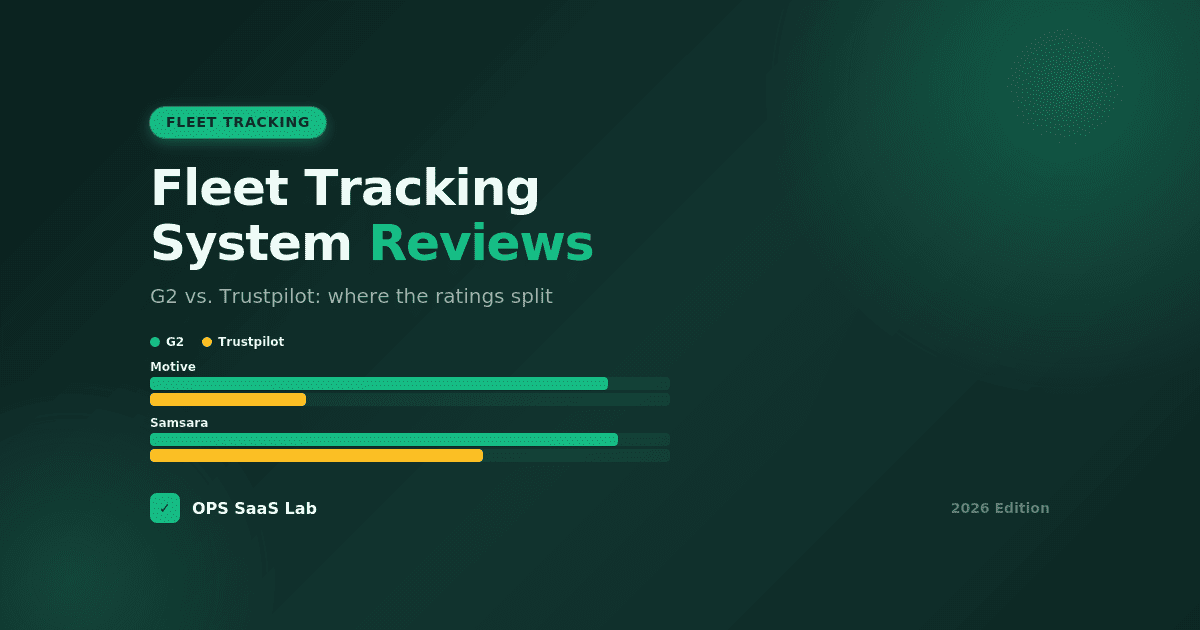
Quick answer: Fleet tracking system reviews vary sharply by source. Samsara and Geotab lead on G2 (4.5/5 each), but Motive’s Trustpilot score (1.5/5) sits dramatically below its G2 score (4.4/5) — a pattern that shows up, to varying degrees, across nearly every major platform. Support and billing complaints, not tracking accuracy, dominate the negative reviews.
Table of Contents
How We Gathered Fleet Tracking System Reviews
Every rating and complaint pattern below comes from G2, Capterra, or Trustpilot — cross-referenced across at least two of the three wherever possible, since relying on a single review platform for this category is genuinely misleading, as the section below explains. Pros and cons are paraphrased from patterns across many reviews, not lifted from any single review’s exact wording.
We looked specifically for platforms with enough review volume on more than one site to make a real comparison — a handful of fleet tracking products have only a handful of reviews anywhere, which isn’t enough to draw a pattern from, so we left those out.
Fleet Tracking Ratings at a Glance
| Platform | G2 Rating | Trustpilot Rating | Review Volume (approx.) | What Reviewers Consistently Say |
|---|---|---|---|---|
| Samsara | 4.5/5 | 3.2/5 | 4,000+ (G2), 500+ (Trustpilot) | Strong tracking and UX; billing and contract complaints on Trustpilot specifically |
| Geotab | 4.5/5 | 4.1/5 | ~200 (G2), small sample (Trustpilot) | Powerful and customizable; steep learning curve, basic fuel tools |
| Motive | 4.4/5 | 1.5/5 | 3,000+ (G2), 2,300+ (Trustpilot) | Clean mobile app; the widest G2-Trustpilot gap in this list |
| Verizon Connect | 3.8/5 | 3.5/5 | ~960 (G2), ~880 (Trustpilot) | Closest G2-Trustpilot agreement; support is the dominant complaint on both |
| Azuga | 4.4-4.5/5 | Reported inconsistently (1.7-3.3/5 across sources) | Varies widely by source | Easy to use day-to-day; contract, billing, and device-durability complaints |
Review volumes and scores change continuously and are reported inconsistently across secondary sources — treat these as a directional snapshot, checked 2026, and verify current numbers directly on each platform before deciding.
The G2-vs-Trustpilot Gap: Why It’s Bigger Than You’d Expect
If you’ve compared software categories before, you’ve probably seen review scores vary a little between platforms — half a point here, a few tenths there. Fleet tracking is different. The gap between G2 and Trustpilot scores for the same product, in this category, is often large enough to look like two different products entirely.
Motive is the clearest example: 4.4/5 on G2 against roughly 1.5/5 on Trustpilot — and this isn’t a small, unrepresentative Trustpilot sample skewing the number. That Trustpilot score is built on more than 2,300 reviews, a genuinely large sample. Samsara shows the same pattern at a smaller scale: 4.5/5 on G2 versus 3.2/5 on Trustpilot, a gap of over a full point.
Verizon Connect is the outlier in the other direction — its G2 (3.8/5) and Trustpilot (3.5/5) scores sit close together, within half a point.
Why the gap exists at all is worth understanding, not just noting. G2 reviews are frequently collected through structured prompts — sometimes incentivized, often gathered by the vendor’s own customer success team during a positive moment in the relationship. Trustpilot reviews are unprompted and skew toward people motivated enough to write one unsolicited — disproportionately after a billing dispute, a hard cancellation, or a support failure. Neither source is “the truth” on its own. Read as a pair, the gap itself becomes useful information: a wide one signals that satisfied users and frustrated users have very different experiences with the same product, not that one score is fake.
Read the Gap for Any Platform
Evaluating a platform that isn’t covered here? Enter its two scores and see what the gap is telling you.
How many Trustpilot reviews?
TP = Trustpilot
Rule of thumb drawn from the platforms in this review: a gap under half a point suggests a consistent experience; a gap near a full point or more, on a large sample, means the negative experiences are real. Neither score is “the truth” on its own.
What Real Users Say About Each Platform
Samsara
Samsara holds the highest G2 average in this list (4.5/5, from a review base in the thousands) alongside the widest Trustpilot gap after Motive.
What reviewers praise: Real-time tracking accuracy and a genuinely modern interface come up repeatedly, alongside strong AI dashcam and driver-safety features. G2 reviewers rate its ease-of-use notably higher than several competitors in side-by-side comparisons.
What reviewers consistently flag: Trustpilot reviews cluster around billing, auto-renewal terms, and difficulty canceling — a pattern distinct from complaints about the tracking technology itself. The standard 36-month contract comes up often as a source of frustration when a business's needs change mid-term.
Geotab
Geotab posts a strong G2 average (4.5/5) with relatively few reviews compared to Samsara or Motive, and one of the smaller G2-Trustpilot gaps in this list.
What reviewers praise: Depth of data and customization draw consistent praise — reviewers describe genuinely granular visibility into vehicle performance and driver behavior, useful for larger or more technically-minded fleet operations.
What reviewers consistently flag: That same depth creates a real learning curve; new users report the volume of available data as overwhelming before they learn to navigate it. Reviewers also describe the built-in fuel card system as basic, often requiring a third-party add-on for real precision, and note that return on investment scales with fleet size — strong at hundreds of vehicles, less clearly worth it at 10-20.
Motive
Motive shows the sharpest split in this entire list: a strong 4.4/5 on G2 against roughly 1.5/5 on Trustpilot, built on a large review base on both sides.
What reviewers praise: A clean, driver-friendly mobile app and straightforward ELD compliance workflow are the most consistent positives across sources.
What reviewers consistently flag: Customer support is the recurring theme in negative reviews — described as difficult to reach quickly, with long hold times reported in specific accounts. Dash cam footage quality has been criticized as low-resolution in some reported cases, and safety alerts have been described as inconsistent, occasionally missing events they're meant to catch. Contract and billing complaints echo the pattern seen with Samsara, but appear more frequently in Motive's Trustpilot reviews specifically.
Verizon Connect
Verizon Connect posts the lowest G2 average in this list (3.8/5), but also the closest agreement between G2 and Trustpilot (3.5/5) — a half-point gap rather than a multi-point one.
What reviewers praise: Core GPS tracking and reporting function reliably for most day-to-day use cases, and the platform integrates well for businesses already inside the Verizon ecosystem.
What reviewers consistently flag: Customer support is, by a clear margin, the most consistently cited complaint across G2, Capterra, Trustpilot, and the Better Business Bureau alike — specifically slow response times and, in a number of reported cases, continued billing after a customer believed they had canceled. The interface is also frequently described as dated relative to newer entrants like Samsara.
Azuga
Azuga's ratings are the least consistent in this list — G2 scores commonly cited between 4.4 and 4.5, while Trustpilot figures are reported anywhere from roughly 1.7 to 3.3 depending on the source and when it was checked, sometimes based on very different review counts. That inconsistency is itself worth flagging rather than smoothing over.
What reviewers praise: Day-to-day usability, real-time tracking, and driver behavior monitoring draw consistent praise, and several reviewers specifically mention reduced insurance costs tied to improved driving habits.
What reviewers consistently flag: Contract terms and auto-renewal transparency are the most common complaint theme, alongside occasional reports of GPS device durability and accuracy issues. A number of Better Business Bureau complaints reference unsolicited sales calls following a free-trial form submission, separate from complaints about the tracking product itself.
The Complaint Pattern That Cuts Across Every Platform
Read enough of these reviews across all five platforms and one pattern is impossible to miss: the loudest complaints are almost never about whether the GPS dot is accurate. They're about billing, contract terms, cancellation difficulty, and how hard it is to reach a human when something goes wrong.
This matters for how you should actually use star ratings in this category. A platform with a lower overall score but simple, transparent billing may cause you fewer headaches than a higher-rated one with rigid multi-year contracts — the rating alone doesn't tell you which problem you're signing up for. Before comparing scores further, it's worth reading the actual cancellation and contract terms — covered directly in Best Fleet Tracking Devices: Top 10 Compared, which includes a calculator for exactly this kind of early-exit cost.
Who Published the "Samsara Is #1" Study?
You'll find a specific statistic circulating in comparison content: Samsara scoring highest in a 2025 fleet technology satisfaction study, ahead of Geotab, Motive, Verizon Connect, and Azuga. It's worth knowing where that number comes from before treating it as independent confirmation of everything above.
That study — the Comparison of Fleet Management Technology Providers — is published and hosted by Samsara itself, about its own product, on its own website. That doesn't make the underlying survey data fabricated, and the relative ordering it shows is broadly consistent with the independent G2 and Trustpilot patterns above. But it's Samsara-commissioned research about Samsara's own ranking, which is a different kind of source than the third-party review platforms the rest of this page draws from — the same distinction worth applying to any vendor-published "we're #1" statistic in any software category, not just this one.
Fleet Tracking System vs. Fleet Monitoring System: Same Thing?
Largely yes. "Fleet tracking system" and "fleet monitoring system" are used interchangeably across review platforms and vendor marketing alike, both referring to software that uses GPS and telematics data to track vehicle location, status, and driver behavior in real time. Where a distinction sometimes gets drawn, "monitoring" leans slightly toward the ongoing, real-time dashboard view, while "tracking" is used more broadly to include historical trip and route data too — but in practice, the same platforms cover both, and reviewers don't distinguish between the terms in any consistent way.
How to Weigh These Reviews Before You Buy
A few practical filters, based on the patterns above:
- Check both G2 and Trustpilot before trusting either alone. A small gap suggests a consistent experience. A gap of a full point or more, especially on a large Trustpilot sample, means the negative experiences are real and worth understanding before you sign — not statistical noise.
- Read for the complaint category, not just the star count. A cluster of billing and cancellation complaints tells you something different than a cluster of feature complaints — and matters differently depending on how much you value contract flexibility.
- Weight reviews by your own fleet size. Several patterns above — Geotab's learning curve, Samsara's ROI at scale — depend heavily on how many vehicles you're running. A review from a 500-vehicle enterprise fleet doesn't necessarily predict your experience at 15.
- Ask directly about contract and cancellation terms during the sales process, and get the answer in writing. This single question would have prevented a large share of the complaints found across every platform in this review.
What Matters Most to Your Fleet?
Pick a priority. See which way the reviews lean, what to watch for, and the one question to ask the vendor.
Based on patterns across G2, Capterra, and Trustpilot reviews. This shows where reviewers' experiences cluster, not a recommendation; fit depends on your fleet size and contract terms.
For the broader category — GPS versus telematics versus a full fleet management system, and realistic pricing — start with our pillar guide, Fleet Tracking Software: The Complete Buyer's Guide for 2026. For a closer look at one specific platform's current review text, Geotab's G2 reviews page is a reasonable starting point — though as this guide shows, checking it alongside Trustpilot gives a more complete picture than either alone.
FAQs (Fleet Tracking System Reviews)
What is the best fleet tracking system?
There's no single best system. Samsara and Geotab lead on G2 ratings, Verizon Connect shows the most consistent scores across review platforms, and the right fit depends heavily on fleet size, budget, and how much contract flexibility you need.
What is the best fleet maintenance tracking system?
Fleet tracking systems handle location and telematics; maintenance-specific tracking is often paired with or built into a CMMS. Platforms like Fleetio position themselves around maintenance tracking first, with telematics second.
How much does fleet GPS tracking cost?
Most platforms run roughly $20-45 per vehicle monthly for core tracking, with enterprise-tier platforms like Samsara reaching $40-60+ with add-ons like AI dashcams. Many require multi-year contracts, which matters as much as the monthly rate.
What are the top fleet management software platforms?
By review volume and G2 rating, Samsara, Geotab, Motive, Verizon Connect, and Azuga are the most frequently reviewed platforms in this category, each with a different balance of strengths and recurring complaints.
What are the best tracking systems for trucks?
For regulated commercial trucking specifically, Motive and Samsara are the most frequently reviewed for ELD compliance, though Motive's support and Trustpilot scores are notably weaker than its G2 rating alone would suggest.
What is smart fleet management?
Smart fleet management refers to using connected telematics data — GPS, engine diagnostics, driver behavior, and predictive maintenance alerts — to make proactive operational decisions, rather than reacting to problems after they happen.
What is a fleet monitoring system?
A fleet monitoring system is software that displays real-time vehicle location, status, and driver behavior data collected from GPS and telematics hardware — functionally the same category most vendors also call a fleet tracking system.
What is the best app for fleet management?
Mobile app quality varies significantly by platform. Motive and Samsara both draw praise for driver-facing app design specifically, though app quality and backend reliability (support, billing) are frequently reviewed as separate issues.
What are the pillars of fleet management?
Fleet management is commonly broken into vehicle acquisition, maintenance, fuel and cost management, driver safety and compliance, and route and dispatch optimization — with tracking software touching all five to varying degrees.
Do fleet tracking reviews on G2 and Trustpilot usually agree?
Not consistently, and the gap can be large. Motive rates 4.4/5 on G2 but roughly 1.5/5 on Trustpilot — a pattern seen to a lesser degree across most platforms in this category. Checking both gives a more reliable picture than relying on either alone.